
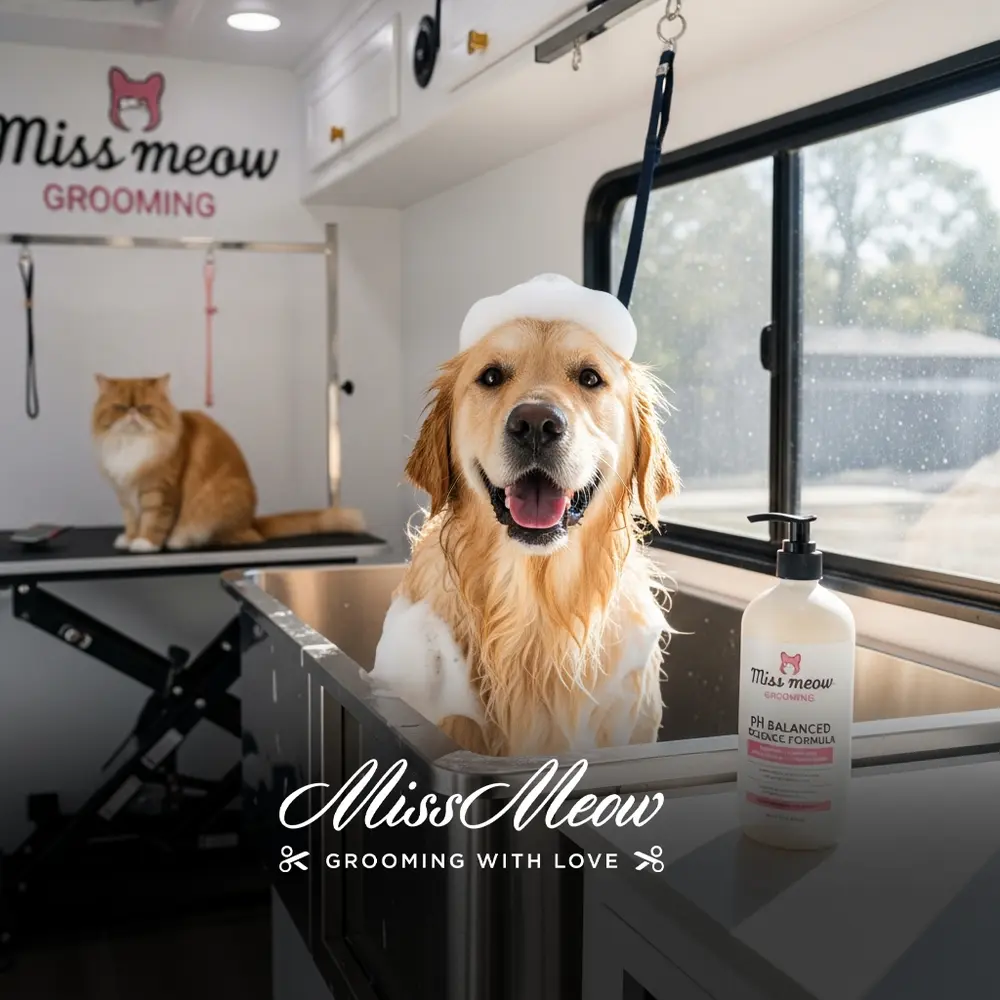
The Science of Pet Shampoos: pH Balance Explained
Imagine this: it is a sunny Saturday afternoon, and your energetic golden retriever has just decided that a mud puddle in the backyard is the perfect place for a nap. Or perhaps your elegant Persian cat has managed to get a mysterious, sticky residue on her pristine coat. Your first instinct, quite naturally, is to reach for a bottle of shampoo. But before you grab that luxury lavender-scented bottle from your own shower shelf, there is a fundamental biological reality you need to consider. The skin of your pet is not just a fuzzy version of your own; it is a complex, delicate organ with a chemical requirement that differs vastly from human biology. This brings us to a crucial topic for every pet owner: The Science of Pet Shampoos: pH Balance Explained.
Why does it matter so much? Let’s be honest, many of us assume that “soap is soap.” However, the chemistry of cleaning agents can either support the health of your pet’s skin or strip away its natural defenses, leading to a cascade of dermatological issues. Understanding the science of pet shampoos: pH balance explained, is the first step toward ensuring your furry companion doesn’t just look clean, but stays healthy from the follicle down. In this comprehensive guide, we will dive deep into the world of acidity, alkalinity, and the invisible barrier that protects our pets from the harsh elements of the world.
What Exactly is pH and Why Does It Matter for Pets?
To understand the science of pet shampoos: pH balance explained, we must first revisit high school chemistry for a brief moment. The pH scale, which stands for “potential of hydrogen,” measures how acidic or alkaline a substance is. The scale runs from 0 to 14. A pH of 7 is considered neutral—pure water sits right here. Anything below 7 is acidic (like lemon juice or vinegar), and anything above 7 is alkaline (like baking soda or bleach).
Human skin is naturally acidic, typically falling between a pH of 5.2 and 5.5. Because of this, human shampoos are formulated to maintain that acidity. On the other hand, the skin of dogs and cats is much closer to neutral, and in many cases, it leans toward the alkaline side. Most dogs have a skin pH ranging from 6.2 to 7.5, while cats typically hover around 6.4 to 6.8. When you use a product designed for human skin on a pet, you are essentially dousing their body in a substance that is hundreds of times more acidic than their natural state. This disruption is where the trouble begins.
The Acid Mantle: Your Pet’s Invisible Shield
The science of pet shampoos: pH balance explained is deeply tied to a biological structure known as the “acid mantle.” This is a very thin, slightly acidic layer on the surface of the skin that acts as a barrier against bacteria, viruses, and environmental pollutants. It is composed of sebum (natural oils) and sweat. For humans, this mantle is quite robust because our skin is thicker—about 10 to 15 layers of skin cells deep. In contrast, a dog’s skin is only about 3 to 5 layers thick. This makes their protective barrier significantly more fragile.
When you use the wrong shampoo, you effectively “strip” this acid mantle. Without this protective layer, the skin becomes vulnerable. It loses moisture through a process called transepidermal water loss, leading to dry, flaky, and itchy skin. Furthermore, an imbalanced pH creates an inviting environment for “bad” bacteria and yeast to flourish. Have you ever noticed your dog smelling “yeasty” or “corn-chippy” shortly after a bath? That is often a sign that their pH balance has been thrown off, allowing microbes to overpopulate. This is why choosing mobile pet grooming in Dubai can be so beneficial, as professionals utilize products specifically calibrated for the unique skin chemistry of pets living in arid climates.
The Science of Pet Shampoos: pH Balance Explained in Depth
When we look at the science of pet shampoos: pH balance explained, we have to look at the ingredients list. Professional-grade pet shampoos are not just diluted human soaps. They are formulated with surfactants—the agents that lift dirt and oil—that are gentle enough to clean without penetrating the deeper layers of the skin. If a shampoo is too alkaline, it can cause the hair shaft to swell and the cuticle to open, leading to tangles and matting. If it is too acidic, it can cause chemical burns or severe irritation.
In fact, the formulation of a high-quality pet shampoo is a delicate balancing act. It must be strong enough to remove the oils that trap odors but mild enough to leave the acid mantle intact. This is why many owners prefer to rely on experts. For those who want the best for their feline friends, specialized cat grooming services ensure that the products used are specifically tailored to the sensitive skin of a cat, which differs even from that of a dog. Cats, being fastidious self-groomers, also need shampoos that leave no toxic residues, as they will likely lick their fur after a bath.
The Consequences of pH Imbalance
What happens when we ignore the science? The results aren’t just a bit of itching. Chronic use of improper shampoos can lead to more serious conditions like atopic dermatitis or secondary skin infections. Let’s look at a common scenario: a dog owner uses their own moisturizing shampoo on their pup. Initially, the dog smells great. However, within 24 hours, the dog is scratching incessantly. The owner thinks the dog is still dirty and washes them again. This creates a vicious cycle where the skin’s pH is never allowed to recover, leading to raw spots, hair loss, and potentially expensive vet bills.
By understanding the science of pet shampoos: pH balance explained, we realize that “moisturizing” for a human means something entirely different than it does for a pet. A pet’s skin needs to maintain its natural oil balance, not be coated in heavy synthetic waxes or oils that are designed for the more acidic human epidermis. This is one reason why a professional dog grooming van in Dubai is equipped with a variety of shampoos—some for deep cleaning, some for sensitive skin, and some for medicated needs—all while keeping the pH at the forefront of the treatment.
The Role of Ingredients in Maintaining Balance
Beyond just the pH number, the quality of the ingredients plays a massive role. Let’s talk about sulfates. Sodium Lauryl Sulfate (SLS) is a common foaming agent in human shampoos. While it creates a satisfying lather, it is often too harsh for pets. It can strip the skin so thoroughly that the body overcompensates by producing even more oil, leading to a greasy coat and a clogged pore situation. Professional formulations often use gentler alternatives derived from coconut or oats.
Furthermore, Missmeow Grooming emphasizes the use of products that are free from harsh dyes and synthetic fragrances that can trigger allergic reactions. When you look at the science of pet shampoos: pH balance explained, you also have to consider the “dwell time”—how long the shampoo stays on the skin. A balanced shampoo allows the active ingredients (like aloe vera, vitamin E, or oatmeal) to soothe the skin without the base surfactants causing irritation during the five to ten minutes it takes to work through a thick coat.
Comparing Dogs and Cats: Are They the Same?
One common mistake is assuming that a “pet shampoo” is a one-size-fits-all solution for both dogs and cats. While their pH levels are closer to each other than to humans, they are not identical. Cats are particularly sensitive to essential oils and certain chemicals that might be perfectly safe for a dog. For instance, tea tree oil or certain citrus extracts can be toxic to cats if absorbed through the skin or ingested during grooming. The science of pet shampoos: pH balance explained must include the warning that feline skin is thinner and more reactive than canine skin.
This is why professional groomers spend years studying the differences. When you look into Miss Meow pricing and packages, you aren’t just paying for a haircut; you are paying for the expertise of someone who knows which specific bottle of shampoo is safe for your specific breed and species. A husky with a thick double coat has different needs than a hairless Sphynx cat, and the chemical balance of the products used must reflect those differences.
The Impact of Water Quality on pH
Interestingly, the science of pet shampoos: pH balance explained isn’t just about what’s in the bottle; it’s also about what’s coming out of your faucet. In many regions, tap water is “hard,” meaning it has a high mineral content (like calcium and magnesium). Hard water tends to be more alkaline. When you mix alkaline water with a shampoo, it can change the effective pH of the solution on your pet’s skin. Professional grooming setups often use water softening or filtration systems to ensure that the water itself isn’t sabotaging the pH-balanced shampoo.
How to Choose the Right Shampoo at Home
If you must wash your pet at home, how do you apply the science of pet shampoos: pH balance explained? First, ignore the marketing fluff on the front of the bottle and look at the back. Look for labels that explicitly state “pH balanced for dogs” or “pH balanced for cats.” Avoid anything that doesn’t specify this balance. Second, look for natural anti-inflammatory ingredients like chamomile or calendula if your pet has sensitive skin.
However, let’s be honest: washing a large dog in a bathtub or trying to bathe a cat that hates water is a recipe for a messy bathroom and a stressed-out pet. Sometimes, the most scientific approach is to leave it to the pros. You can easily book a pet grooming appointment to ensure that your pet receives a spa-like experience with the exact chemical balance their skin craves, all in the comfort of your driveway.
Common Myths About Pet Hygiene
There are several myths that persist despite the science of pet shampoos: pH balance explained. One of the most common is that “dish soap is the best way to get a pet clean.” While dish soap is excellent for removing oil (which is why it’s used on wildlife after oil spills), it is extremely alkaline and harsh. Using it regularly on a domestic pet will eventually destroy their skin barrier. Another myth is that “pets shouldn’t be bathed often.” While over-bathing with the wrong shampoo is bad, regular bathing with a correctly balanced shampoo is actually beneficial for removing allergens and dead skin cells.
The key is frequency and formulation. A dog with skin allergies might actually need a bath once a week with a medicated, pH-neutral shampoo to manage their condition. Conversely, a healthy cat might only need a bath once every few months. The science of pet shampoos: pH balance explained suggests that as long as the acid mantle is respected, hygiene is a pillar of health, not a chore to be feared.
The Future of Pet Skincare
As our understanding of veterinary dermatology grows, the science of pet shampoos: pH balance explained is becoming even more nuanced. We are now seeing the introduction of “probiotic” shampoos that don’t just balance pH, but actively seed the skin with beneficial bacteria to crowd out the bad ones. We are also seeing a shift toward more sustainable, biodegradable ingredients that are as kind to the planet as they are to the pet’s skin.
Professional services are at the forefront of these advancements. By choosing a high-end service, you are ensuring that your pet benefits from the latest research in animal science. Whether it is the specific temperature of the water or the precise dilution ratio of the shampoo, every detail matters in maintaining that delicate 6.5 to 7.5 pH window.
Conclusion: A Healthy Coat Starts with Science
In the end, the science of pet shampoos: pH balance explained is about more than just avoiding a “wet dog” smell. It is about respecting the complex biological systems that keep our pets protected from the world. Your pet’s skin is their first line of defense, and as their guardians, it is our job to ensure that defense remains strong. By choosing products and services that prioritize pH balance, you are investing in your pet’s long-term comfort and health.
So, the next time your pet decides to explore a muddy trail or simply needs a seasonal refresh, remember the number 7. Remember the thin acid mantle. And remember that their skin is a unique environment that requires a unique solution. Whether you are DIY-ing the bath or calling in the professionals, keep the chemistry in mind. Your pet might not be able to thank you in words, but their soft, shiny, and itch-free coat will speak volumes.
The science of pet shampoos: pH balance explained is a journey into the microscopic world of our pets, reminding us that even the smallest details—like the acidity of a soap bubble—can make a world of difference in the lives of our beloved animal companions.