
Grooming Tips for Pomeranians to Keep Their Coat Fluffy
Grooming Tips for Pomeranians to Keep Their Coat Fluffy
There is perhaps no dog breed more synonymous with the word “cloud” than the Pomeranian. These tiny, spirited companions are known for their vibrant personalities and, more importantly, their magnificent, voluminous coats. However, achieving that perfect, round, cotton-candy look doesn’t happen by accident. If you have ever looked at your Pom and thought they were looking a little more “flat” than “fluffy,” you are not alone. Maintaining that signature silhouette requires a blend of consistency, the right tools, and a deep understanding of their unique double coat. In this comprehensive guide, we will dive deep into Grooming Tips for Pomeranians to Keep Their Coat Fluffy, ensuring your little lion remains the talk of the neighborhood.
Understanding the Pomeranian Double Coat
Before we pick up a brush, we have to understand what we are working with. Pomeranians possess what is known as a double coat. This consists of a soft, dense undercoat that provides insulation and a longer, harsher outer coat made of guard hairs that stand off the body. It is this combination that creates the “fluff.” If the undercoat becomes compacted or the guard hairs become weighed down by oils and dirt, the fluff factor vanishes. Let’s be honest, a flat-coated Pomeranian is still cute, but they lose that regal, puffball essence we all love.
One of the most important Grooming Tips for Pomeranians to Keep Their Coat Fluffy is to never, ever shave them. Shaving a double-coated dog can permanently damage the texture of the hair and disrupt their natural ability to regulate their temperature. Instead of cooling them down, it leaves them vulnerable to sunburn and heatstroke. The goal of grooming is to manage the hair, not remove it. By focusing on shedding cycles and moisture balance, you can maintain that iconic look without compromising the dog’s health.
Daily Brushing: The Foundation of the Fluff
If you want a fluffy Pomeranian, you have to get comfortable with a brush. This isn’t a once-a-week task; it is a daily commitment. Brushing serves two purposes: it removes loose fur from the undercoat before it can form mats, and it stimulates the skin’s natural oils, distributing them along the hair shaft for a healthy shine. However, simply dragging a brush over the top isn’t enough. You need to practice “line brushing.”
Line brushing involves parting the hair and brushing from the skin outward in small sections. This ensures you are reaching the dense undercoat where tangles often hide. For those living in busy urban environments, finding the time for this can be tricky. This is why many owners opt for mobile pet grooming in Dubai to ensure their pets get professional-level maintenance right at their doorstep. A professional can help clear out the “dead” hair that prevents the coat from standing upright.
Essential Tools for the Perfect Pom-Puff
You wouldn’t try to paint a masterpiece with a house-painting brush, and you shouldn’t groom your Pom with subpar tools. To follow our Grooming Tips for Pomeranians to Keep Their Coat Fluffy, you need a specific kit. First, a high-quality slicker brush with fine, flexible pins is non-negotiable. This is your primary tool for fluffing the hair and removing debris. Second, a stainless steel greyhound comb is essential for checking your work; if the comb can’t slide through the hair easily, there is a hidden knot that needs attention.
Furthermore, consider a dual-sided pin brush for finishing touches and a dematting tool for those stubborn spots behind the ears. Using these tools correctly prevents the coat from laying flat. In fact, many people who also own cats find that the tools used in professional cat grooming services—specifically the fine-toothed combs—are surprisingly effective for the delicate hair around a Pomeranian’s face and ears.
Bathing for Volume: Not All Shampoos are Equal
Bathing a Pomeranian is a bit of an art form. If you use a heavy, oil-laden shampoo, you will weigh down the hair, resulting in a sleek but decidedly non-fluffy dog. To keep the coat standing tall, you want a volumizing shampoo. These formulas are designed to open up the hair cuticle slightly or coat the hair in proteins that add “body.” However, you must be careful not to over-strip the coat of its natural moisture, which can lead to brittle hair and breakage.
Always follow up with a light, leave-in conditioner or a diluted rinse-out conditioner. The trick is to apply conditioner only to the ends of the guard hairs and avoid the roots, as heavy conditioning at the skin level is the fastest way to lose volume. If you find the bathing process overwhelming, calling a dog grooming van in Dubai can take the stress off your hands. These vans are equipped with professional-grade tubs and high-velocity dryers that are far more effective than your standard home hairdryer.
The Magic of the High-Velocity Dry
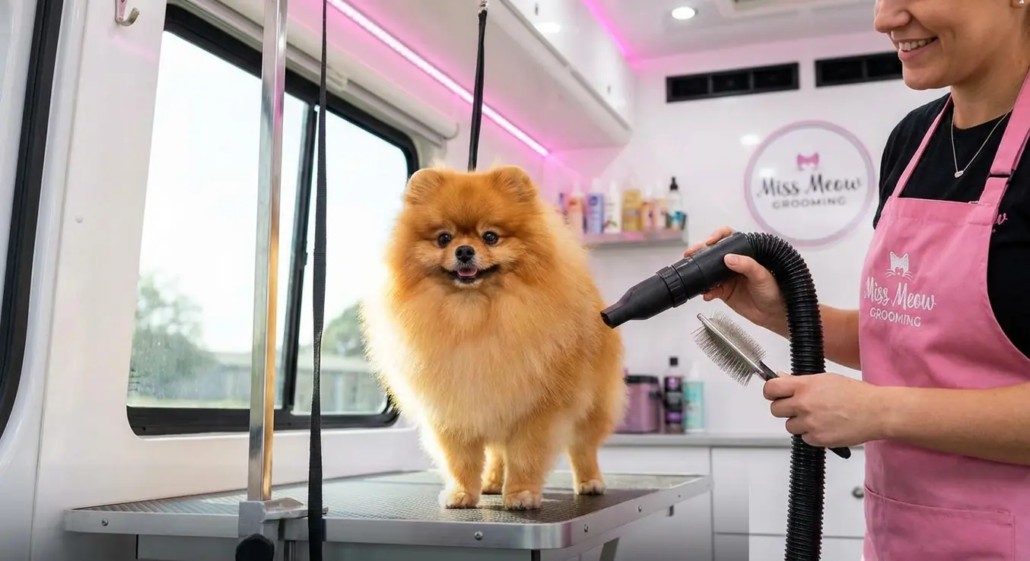
If there is one “secret” among the Grooming Tips for Pomeranians to Keep Their Coat Fluffy, it is the method of drying. Rubbing a Pomeranian with a towel is a recipe for disaster; it creates friction, causes tangles, and flattens the hair. Instead, you should gently pat them dry and then use a high-velocity dryer. These machines don’t rely on high heat, which can damage the hair; instead, they use a powerful stream of air to “blast” the water out of the coat and separate every individual hair strand.
As you dry, use your slicker brush to brush the hair against the direction of growth. This technique, often called “force drying,” is what gives Pomeranians that perfectly round, dandelion-clock appearance. If you are doing this at home, ensure the dryer is on a cool or warm setting. For those who want this salon-quality finish without the mess in their bathroom, check out the Miss Meow pricing and packages to see how an expert groomer can handle the blow-out for you. A professional finish lasts much longer than a DIY one.
Dealing with Mats and Tangles Safely
Even with the best intentions, mats can happen. They usually form in high-friction areas: behind the ears, under the armpits, and around the “trousers” (the back of the thighs). When you find a mat, don’t reach for the scissors immediately. Cutting out a mat often leaves a visible “hole” in the fluff that can take months to grow back. Instead, use a detangling spray and your fingers to gently tease the knot apart.
Once the mat is loosened, use the end of your metal comb to pick it apart slowly. This patience is a key part of our Grooming Tips for Pomeranians to Keep Their Coat Fluffy. If the matting is too severe, it may be time to seek professional help. Missmeow Grooming professionals are trained to handle “pelted” or matted coats with care, ensuring the dog remains comfortable while preserving as much of the coat as possible. Preventing mats is always easier than removing them, so pay extra attention to those friction-prone areas during your daily brushing sessions.
The Role of Nutrition in Coat Fluffiness
We often talk about what we put *on* the coat, but what we put *into* the dog is just as important. A dull, flat coat is often a sign of nutritional deficiencies. To keep that coat fluffy and resilient, a Pomeranian needs a diet rich in Omega-3 and Omega-6 fatty acids. These healthy fats nourish the hair follicles and ensure the guard hairs are strong enough to stand upright rather than snapping or laying flat.
Hydration also plays a massive role. Dehydrated skin leads to dry, brittle hair that loses its “bounce.” Ensure your Pom always has access to fresh water, especially in warmer climates like the UAE. If you notice your dog’s coat looking particularly lackluster, a consultation with a vet or a high-end groomer might reveal that a supplement change is needed. A healthy dog is a fluffy dog, and no amount of brushing can compensate for poor internal health.
Trimming for Shape, Not for Length
While we’ve established that shaving is a big no-no, trimming is absolutely necessary to maintain a tidy, fluffy look. Pomeranians tend to grow long hair between their paw pads and around their “sanitary” areas. Keeping these areas trimmed prevents them from tracking in dirt or becoming stained. Additionally, a light “toss-up” or “outline trim” can help accentuate the roundness of the coat.
When trimming for fluff, the goal is to remove the “stragglers”—those long, thin hairs that stick out beyond the main silhouette. By trimming these back to the level of the dense coat, you create a more compact and voluminous appearance. This requires a steady hand and professional-grade shears. If you’re not confident with scissors near a wiggly dog, it’s always safer to book a pet grooming appointment and let a stylist handle the shaping. They can give your Pom that perfect “show-ring” circle that is hard to achieve at home.
The “Puppy Uglies” and Seasonal Shedding
If you have a young Pomeranian between 4 and 8 months old, you might notice them losing their fluff in patches. Don’t panic! This is a natural phase known as the “puppy uglies.” During this time, they shed their soft puppy fur to make way for their adult double coat. It can look a bit moth-eaten and straggly, but it’s a necessary transition. During this phase, continue following these Grooming Tips for Pomeranians to Keep Their Coat Fluffy to ensure the new growth comes in healthy.
Adult Poms also go through seasonal “blow outs,” usually twice a year. During these periods, they will lose a massive amount of undercoat in a short window of time. If this dead hair isn’t brushed out, it will get trapped and cause the coat to look flat and matted. Increasing your brushing frequency to twice a day during shedding season is the only way to keep the fluff alive while your vacuum cleaner works overtime.
Professional Grooming: Why It’s Worth It
Let’s be honest: grooming a Pomeranian is a lot of work. It is a labor of love, but it is also time-consuming and physically demanding. Professional groomers have access to tools that the average owner doesn’t—like high-velocity dryers, specialized de-shedding shampoos, and ergonomic grooming tables that keep the dog still and safe. Regular professional visits ensure that the deep undercoat is thoroughly cleaned and that any potential skin issues are caught early.
For many owners, the convenience of having a professional come to them is a game-changer. It reduces the stress on the dog, who doesn’t have to deal with a long car ride or a noisy shop full of other barking dogs. A calm dog is much easier to groom, resulting in a better, fluffier finish. Whether you do it yourself or hire help, consistency is the ultimate secret.
Common Mistakes That Ruin the Fluff
In our journey through Grooming Tips for Pomeranians to Keep Their Coat Fluffy, we must highlight some common pitfalls. One of the biggest mistakes is brushing a dry coat. Brushing dry hair can cause static and breakage. Always use a light grooming spray or even a fine mist of water to provide some “slip” to the hair before brushing. Another mistake is neglecting the tail. The “plume” of the tail is a Pomeranian’s pride and joy; it should be brushed outward from the bone to create a fan-like effect.
Finally, don’t ignore the ears. The hair on the ears is finer and more prone to oils, which can make them look “greasy” and flat. A little bit of cornstarch or specialized grooming powder can help absorb excess oil between baths, keeping the head look puffy and alert. By avoiding these small errors, you can significantly improve the overall texture and appearance of your dog’s coat.
Conclusion: The Reward of a Fluffy Friend
There is nothing quite like the feeling of a freshly groomed, ultra-fluffy Pomeranian strutting through the house. It’s a testament to your care and dedication as an owner. While the process of brushing, bathing, and drying might seem daunting at first, it becomes a wonderful bonding time for you and your pet. Remember, the key to the fluff isn’t a magic product; it’s the combination of the right technique, the right tools, and a regular schedule.
By following these Grooming Tips for Pomeranians to Keep Their Coat Fluffy, you ensure that your dog doesn’t just look good, but feels good too. A well-maintained coat prevents skin irritation, keeps them cool in the summer and warm in the winter, and keeps them comfortable. So, grab that slicker brush, put on some music, and start fluffing! Your Pomeranian—and your camera roll—will thank you for it.

Leave a Reply
Want to join the discussion?Feel free to contribute!